Every AI email assistant I tried had the same voice. Polite, slightly breathless, fond of "I hope this email finds you well." Nobody I know writes like that. I certainly don't. I write "Sounds good, will send by Friday" and move on with my life.
So I asked a different question: what if the assistant learned how I write before it wrote anything for me? The best evidence of how I write is already sitting in one place. My sent folder.
That became Email Digital Twin.
Watch it first
The walkthrough shows the whole loop: build a persona from sent mail, open a thread, get four drafts, insert one into Gmail.
How it helps
The value is not "AI writes your email." Plenty of tools do that. The value is that the draft already sounds like you, so the edit is a tweak instead of a rewrite.
In practice, that means:
- Less editing. Drafts mirror your usual length, formality, greetings, and sign-offs.
- A choice, not a guess. You get four variants (Formal, Concise, Casual, and Context-adjusted) and pick the one that fits the thread.
- Tone that reads the room. If a thread is tense or asks for action, the Context-adjusted draft becomes more polite or more assertive accordingly.
- It stays inside Gmail. The extension adds two buttons, Build Persona and Draft Reply, and inserts the chosen draft directly into the reply box.
The architecture
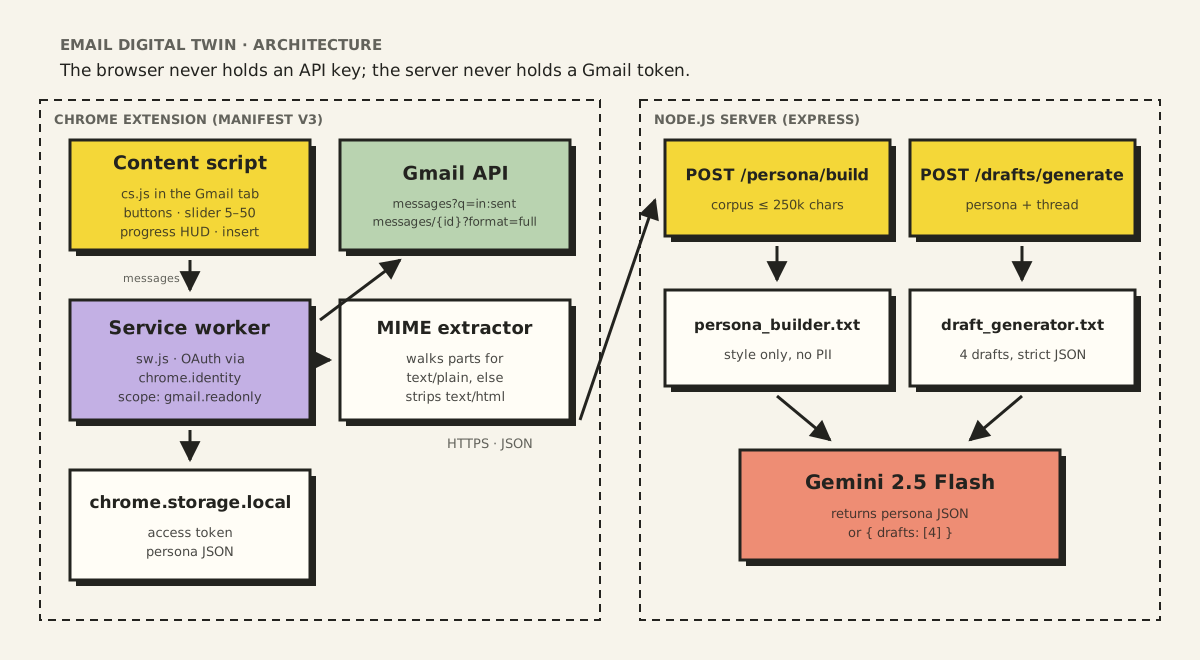
The system is split along one line: who holds which secret.
- The Chrome extension holds the user's Gmail access token. It talks to Gmail directly, so the token never leaves the browser.
- The Node.js server holds the Gemini API key. It never sees a Gmail token, only the text the extension chooses to send it.
That split shaped every other decision.
Inside the extension
Manifest V3 extensions have two kinds of code, and the project uses both:
- The content script (
cs.js) runs inside the Gmail tab. It adds the Build Persona and Draft Reply buttons, shows the slider and a live progress display, and inserts the chosen draft into Gmail's reply box. It can touch the page, but it can't make privileged requests. - The service worker (
sw.js) runs in the background. It owns OAuth, calls the Gmail API, and talks to the server. The content script asks it to do things by message (BUILD_PERSONA,DRAFT_REPLY), and the service worker reports progress back.
Signing in
OAuth runs through chrome.identity.launchWebAuthFlow, with a redirect address of the form https://<extension-id>.chromiumapp.org/, which Chrome intercepts so the token comes straight back to the extension. The requested scope is exactly one: gmail.readonly.
The token and the account's email address are stored in chrome.storage.local, and Sign out removes both.
Reading sent mail
Building a persona happens in three visible phases, each reported to the progress display:
- Listing. One Gmail API call:
messages?q=in:sent&maxResults=N, where N comes from the slider (5 to 50). - Fetching. Each message is read with
format=full, and the progress counter ticks up one message at a time. - Analyzing. The cleaned text goes to the server.
The fetching step hides the most interesting code. An email isn't a string; it's a tree of MIME parts. A message might be multipart/alternative with a plain-text and an HTML version, nested inside multipart/mixed with attachments. The extractor walks that tree recursively, returns the first text/plain part it finds, and only falls back to stripping tags from text/html when no plain version exists. Each message body is capped at 4,000 characters, and the server keeps at most the last 250,000 characters of the combined corpus.
Two prompts, two routes
The server has two routes, each paired with a prompt file kept outside the code so it can be read and changed on its own.
| Route | Input | Prompt file | Output |
|---|---|---|---|
POST /persona/build | sent-mail bodies | persona_builder.txt | a JSON persona: formality, sentence length, voice, tone, typical openings, closings, transitions, sign-off |
POST /drafts/generate | persona + subject, recipients and thread snippet | draft_generator.txt | { "drafts": [4 drafts] }, each with id, label, body and why |
Both call Gemini 2.5 Flash with its thinking budget set to zero. This is a style-matching task, not a reasoning task, and skipping the thinking step makes the response noticeably faster.
The draft route also asks for responseMimeType: "application/json", so the model returns JSON instead of prose that happens to contain JSON.
When the model misbehaves
Asking for JSON reduces malformed output; it doesn't eliminate it. So the server parses defensively:
- Try to parse the whole response.
- If that fails, look for a JSON object at the end of the text (models sometimes add a sentence before it) and parse that.
- If that also fails, or the response has no drafts, return a small set of safe, generic drafts instead of an error.
The persona route has its own fallback: if the response isn't valid JSON, the raw text is kept as style notes, so the second step still has something to work with. Each saved persona is stamped with the time it was built.
The generic fallback drafts are honest about what they are: their why field says "Fallback." A user should always be able to tell when they're looking at a personalized draft and when they're looking at a safety net.
The decisions I'd defend in a review
Read-only on purpose. The tool drafts; you send. An assistant that can't send email on your behalf can't send the wrong email on your behalf either. The narrow scope also makes the consent screen honest.
Style, not memory. The persona prompt explicitly says to generalize patterns and never output names, email addresses, phone numbers, or signatures. The goal is "writes like you," not "remembers your contacts."
Read the sanitized corpus and infer ONLY tone/style features.
Do NOT memorize names, emails, phone numbers, companies, or signatures.
Generalize patterns; never output real names/PII.
Structured output, both times. Both prompts return JSON with a fixed shape. That makes the output testable, lets the UI render four clean cards, and means a malformed response is caught by the parser instead of leaking half a sentence into your reply box.
A "why" for every draft. Each draft includes a one-line explanation of what it changed and why. It's a small thing, but it turns "trust me" into "here's my reasoning."
What it doesn't do (yet)
I'd rather list the limits than have someone discover them:
- The persona is a sketch of your style, not a clone. Ten emails give a rough outline; fifty give a better one.
- It learns from the most recent sent mail, not from a curated sample, so a week of terse replies skews the persona terse.
- The prototype sends text to a backend for analysis. The next step is clearer boundaries about what is processed locally and what leaves the machine.
- The persona is rebuilt on request, not updated as you keep writing. An incremental update would keep it current without re-reading everything.
- There's no evaluation set yet. A fair test would hide some of your real replies, generate drafts for those threads, and measure how close each draft gets to what you actually sent.
What I learned
The biggest lesson wasn't about Gmail or Gemini. It was that personalization is mostly a data question, not a prompt question. I spent days tuning prompts before realizing that the single best improvement was feeding the model better evidence: your actual writing, cleaned up, with private details kept out.
The code is on GitHub, including both prompts.